Home / Knowledge Center / News
A filter grade is not a line on a purchasing checklist. It is the output of a design calculation. Once you fix the target CADR, the shape of the fan's P-Q curve, how thick a filter the housing can take, and the cost ceiling, the grade has only one answer. Done the other way round — grade locked in first and everything designed backwards from it — you will usually end up paying for it in airflow.
1. The Most-Asked Question Is Backwards
“Should this unit run H13?” cannot be answered as asked, because it treats the grade as a given.
The order should be reversed: decide what the finished unit will claim, look at how much static pressure margin the fan has, calculate how much resistance the filter can absorb, and only then settle on the grade. Once a grade is written into the purchasing requirement up front, every engineering trade-off downstream is tied to it. Changing it later costs far more than running the calculation twice at the start.
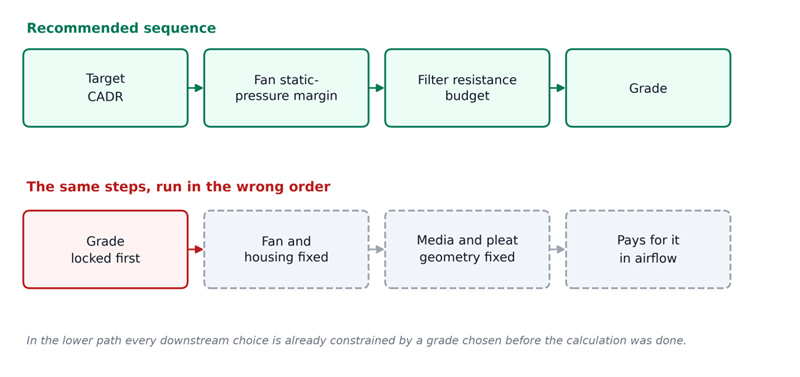
Figure 1 — Grade is an output of the calculation, not an input to it.
2. Raising the Grade Can Pull CADR Down
A higher grade means denser, thicker fibers and tighter pleat spacing, and resistance goes up with it. The fan is the same fan, so airflow can only fall. CADR is airflow multiplied by single-pass efficiency: efficiency up a little, airflow down a chunk, and the product is often a net loss — with noise and power draw rising at the same time.
A common version of this: a housing designed for E12 gets denser media so the copy can say H14. Airflow gets choked, and the measured CADR ends up worse than the original design.
3. Static Elimination Costs a Grade, and the Risk Sits with the Unit Maker
Most HEPA filters used in air purifiers are electret meltblown media, and a meaningful share of their efficiency comes from electrostatic capture. That charge decays: it fades in storage and it fades with moisture. Past a certain point efficiency drops noticeably, and the filter can fall out of its original grade.
The awkward part is that supplier data is usually measured with the charge intact. When the unit maker uses that data to support a finished-product claim and the user never reaches that level, the mismatch is the unit maker's liability. EN 1822 carries a dedicated option for whether static is eliminated, which by itself says this condition belongs in the agreement.
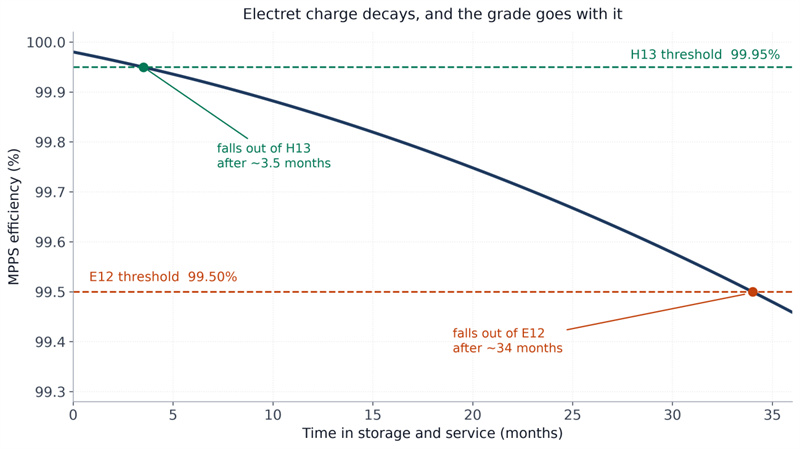
Figure 3 — Thresholds per EN 1822 (H13 ≥ 99.95%, E12 ≥ 99.5% at MPPS). The decay curve is illustrative; the rate depends on media and storage conditions. Supplier data is normally taken with the charge intact.
4. Exporting to the EU and the US: Grades Do Not Carry Over
| System | Basis of classification |
| EN 1822 (EU) | Classified by MPPS efficiency |
| IEST-RP-CC001.7 (US) | TYPE A / TYPE H |
The two systems rest on different criteria and different test conditions. The same filter can come out looking nothing alike under each, and there is no direct conversion. In practice: decide which market you are mainly selling into, then decide which system you report against, and write “which clause of which edition” into the agreement rather than leaving a single grade letter.
5. What the Technical Agreement Has to Spell Out
• MPPS efficiency report: report on MPPS efficiency. Do not supply only a single-point figure at 0.3 µm.
• Resistance curve across multiple airflow points: only a curve shows where the operating point lands once the filter is in the unit.
We are an air purifier factory. When Dongguan Walson supplies air purifier brands and air purifier manufacturers, this test data ships with the samples.
6. Changing Media Suppliers: More Than Efficiency Needs Retesting
A new supplier, a new grade designation, or a new basis weight all count as a change, and after any change both efficiency and resistance must be retested. The usual miss is retesting only efficiency: a resistance change does not appear in an efficiency report. It only shows up in the unit's CADR, and it is often not caught until mass production or a customer complaint.
7. FAQ
Q: Will a higher-grade filter raise the unit's CADR?
A: In most cases it will lower it. Only if the fan carries generous pressure margin can the result go the other way.
Q: Our supplier's H13 report shows a big gap between two batches. Is that normal?
A: No. Check three things first: what test aerosol was used, whether the charge was eliminated, and whether both were tested at the same airflow.
Q: Do the grade designations need to change for EU versus US export?
A: Yes. The two systems rest on different criteria and cannot be converted directly.
Summary
The order is: set the unit specification first, then calculate the resistance budget, and only then settle on the grade. Any claimed grade must state which condition it is accepted under. When changing media suppliers, retest efficiency and resistance together.
About Us
Dongguan Walson Environmental Purifying Technology Co., Ltd. (Walson) is an air purifier factory in Dongguan, Guangdong. We make household air filters, and the air purifier models they fit can be customized. Our customers are air purifier brands and air purifier manufacturers.
Our professional team are waiting for your consultation.
 EN