Home / Knowledge Center / News
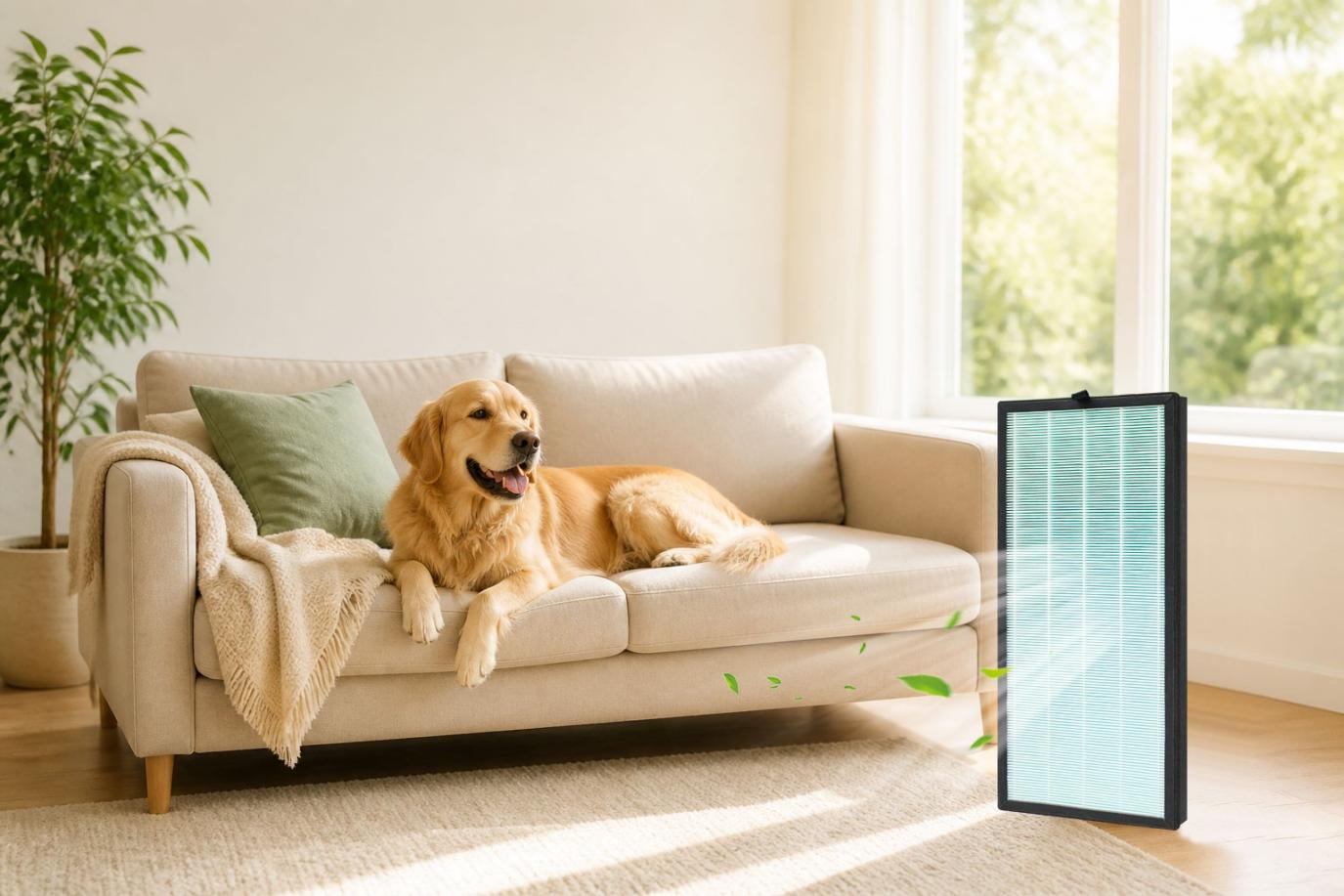
At 6:30 PM, you push open the door after work, and your three cats' "welcome ceremony" always carries something you can't quite name. It's not an uncleaned litter box, nor unopened windows — it's that faint, distinct pet smell lingering in the air. For pet-owning families, this is almost a daily moment: you get used to it, but never truly solve it. The purifier is running, yet the smell seems to cling stubbornly to the furniture fibers.
It wasn't until we seriously studied "where does the smell actually go" that we found the answer hidden in something most people never give a second look — the filter.
Odors don't "smell" — they "settle"
Pet odors are different from dust. Dust is visible — you can wipe it away. But the odor molecules released by pet dander, saliva and waste are extremely small; they float in the air, then slowly "settle" into the fibers of sofas, carpets and curtains. That's why so many families find that "the smell is always there, but we can't locate the source."
A few figures show just how common pet-family air problems are:
· In a survey of pet-owning households, 67.7% of respondents listed "pet hair" as their top indoor air concern (Daikin pet indoor air survey) — and hair is only the visible part; there are far more invisible odor molecules.
· The U.S. EPA notes that indoor air pollutant concentrations can reach 2–5 times outdoor levels; the WHO estimates that about 7 million people die prematurely each year due to air pollution.
For pet-owning families, this isn't a question of "whether to care" — it's "what we're breathing every day."
The activated carbon filter has an "invisible life cycle": it works silently, then quietly fails
Odor adsorption relies mainly on the activated carbon layer — its dense micropores "trap" odor molecules. Sounds simple, but it has one pitfall every pet family will hit: you never know when it has stopped working.
Activated carbon has a finite adsorption capacity. Once saturated, it not only stops adsorbing new odors — it can actually re-release the moisture and odors it previously trapped back into the air. That's why many families find that "the purifier is on, but the smell is getting weirder."
The problem: traditional filters hand the critical judgment of "when to replace" entirely to the user:
| Method | Sounds reasonable | What actually happens |
| Go by feel | "No smell at home, no need to replace" | Odors accumulate gradually — by the time you smell them, the filter has often been saturated and releasing for days |
| Mark the calendar | "Change every 3 months, can't go wrong" | A one-cat apartment and a three-cat household have completely different usage intensity; the calendar fits nobody |
| Smell the machine | "Replace when the vent smells sour" | Sour smell = the saturated layer has already started reverse-releasing — it's already too late |
The common problem with all three: judgment relies on indirect signals, while the filter's true state remains a black box.
Two changes in the new filter: better-targeted adsorption, and a visible status
This new home air purifier filter was built around the real pain points of pet families, in two ways.
Change 1: The adsorption layer is re-formulated for "pet odors"
Unlike generic filters that "absorb a bit of everything," the new filter's adsorption formulation and structure are specifically targeted at the typical sources of pet odors: litter boxes, pet body odor, and waste smells.
Change 2: The filter now "keeps a work log"
This is the most intuitive and memorable change: the filter color gradually deepens with use.
The principle is simple — the adsorption layer keeps accumulating as it continuously captures odors and particles, and the color deepens from light to dark. But "drawing the internal state directly onto the surface in color" is our biggest design gamble — and our biggest sincerity:
· The new filter is light-colored: working status is obvious at a glance;
· After months of use, the color clearly deepens — adsorption is accumulating, performance is declining;
· When the color approaches dark — it's time to replace, no expertise needed.
You don't need to remember "which month to change it." Just glance at the color once in a while. The filter wears its status on its face — that's the "work log" it writes for its owner.
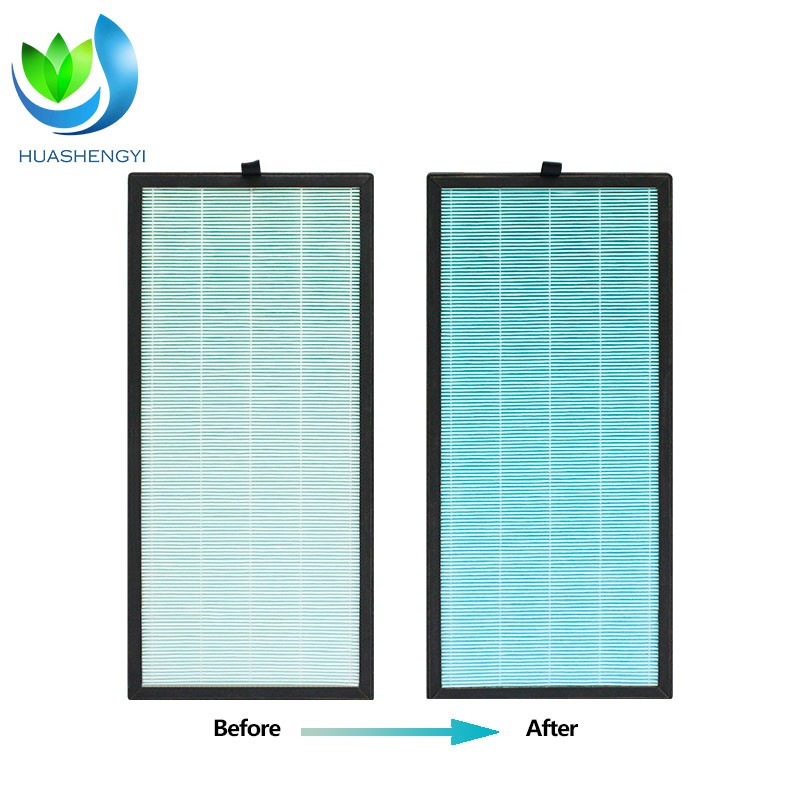
New product photo — filter color comparison before and after use (Before → After)
Every family sees a different color-change speed
This is also why "watching the color" is more practical than "marking the calendar" — because every household faces a different air burden:
· One cat, one dog, daily ventilation: color changes slowly; one filter lasts a long time;
· Three cats, litter box in the living room: high odor concentration, visibly faster color change;
· Purifier running 24/7: fast adsorption accumulation, fast color change;
· Only running at night: slower color change, but odors still accumulate.
The industry rule of thumb — "replace activated carbon filters every 3–8 months, or every 3–6 months for pet families" — can only serve as a reference range. The real replacement signal is your own filter's color.
FAQ
1. Why does the filter color get darker with use?
The adsorption layer continuously reacts with odor molecules; the closer it gets to saturation, the darker the color. It's a "visual dashboard" of usage status, not a dyeing process.
2. Does a darker color mean the filter has failed?
Not instant failure — it's a "time to get ready" signal; only when the color approaches dark is it "time to replace."
3. How much longer can it last after changing color?
There's no one-size-fits-all answer — it depends on pet count, odor concentration, and run time.
4. What's the difference from a regular filter?
Two levels: first, the adsorption formulation is optimized for pet odor sources; second, it adds a color indicator so you know the filter's true state instead of guessing.
5. How soon will I see the color change?
It depends on the environment. The higher the odor concentration and the longer the run time, the faster the change. That's why "color indication" fits real usage better than "fixed intervals."
6. How can I make the filter last longer?
Regularly clean the pre-filter layer (it catches most of the hair), keep the room ventilated, and avoid letting high-concentration odors from around the litter box hit the filter directly for long periods — all of these extend the main filter's effective life.
Closing
Pets bring companionship to a home — and also the homework of air management. This color-changing filter solves two small things: actually absorbing pet odors, and making "it's time to replace the filter" something you no longer have to guess.
The darker it gets, the more it has taken on for you — and when it reaches its limit, at least it will tell you loud and clear.
References
WHO Air Pollution & Health: https://www.who.int/health-topics/air-pollution
EPA Indoor Air Quality: https://www.epa.gov/indoor-air-quality-iaq
Daikin Pet & Indoor Air Survey: https://www.daikinindia.com/pet
Our professional team are waiting for your consultation.
 EN
EN